Summer student projects tackle sustainability challenges on campus and beyond
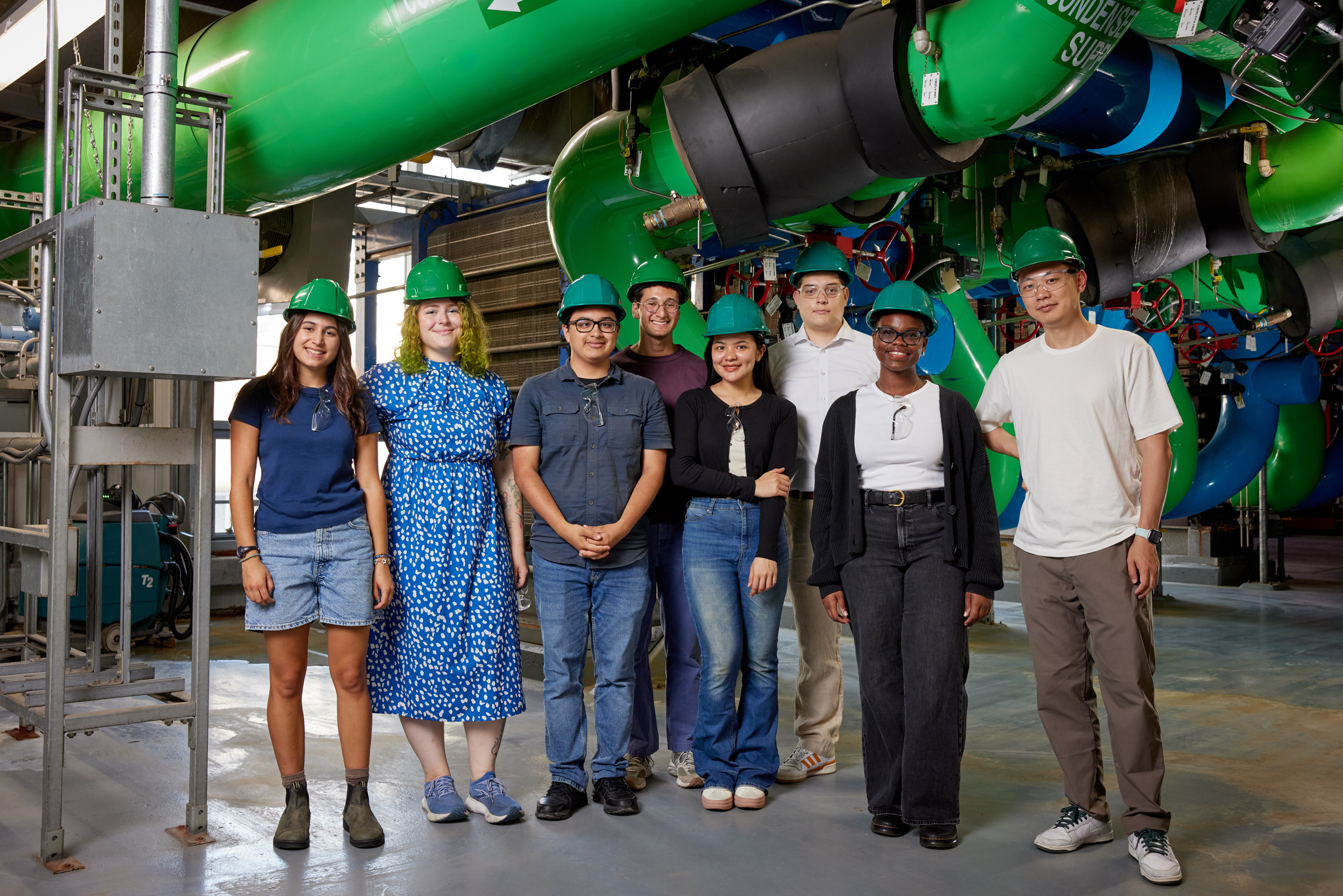
Students in the Campus Climate Action summer student cohort work with MIT Office of Sustainability (MITOS).
Rochelle Griffith, a rising sophomore in the Department of Civil and Environmental Engineering, grew up on the island of Grenada, experiencing firsthand extreme weather patterns resulting from climate change. Inspired to work toward mitigating potential harm, she became passionate about climate equity and creating a more sustainable future.
Griffith is one of nine students — all passionate about making tangible change — participating in a 10-week program with the MIT Office of Sustainability. All members of this cohort contributed to a specific sustainability project on advancing MIT’s climate goals, and they also worked with local organizations to connect their projects with real-world impact.
“Grounded in the foundational efforts over the past decade of the Office of Sustainability, this program [was] designed to bridge the gap between big-picture climate planning and day-to-day decision-making and implementation locally – leveraging the campus and community as a test bed for learning” said Julie Newman, PhD, Director of Sustainability. “The students [were] provided the opportunity to take real data, real constraints, and real climate goals, and ask: ‘What does it take to make progress and have measurable impact right here?’”
This year’s cohort comprised three different projects. Griffith, along with Diego Iglesias Vega (a master’s student in Chemical Engineering) and Tony Wang (a master’s student in the MIT Real Estate Development program), worked on the Decarbonization Accelerator. This project focused on decarbonizing energy sources — especially for heating systems — toward achieving MIT’s climate goal of zero emissions by 2050.
Master of Architecture student Zachary Rapaport and rising sophomore in Civil and Environmental Engineering Rowan Wergeland worked on the Food Systems project, which exploredways to turn underutilized campus sites into planting spaces for urban farming and also aimed to reduce food waste. Sylva Das (a rising senior at Wellesley College majoring in Environmental Studies), Chiara Palagi (a junior majoring in Urban Planning), Santiago Vega (a rising sophomore majoring in Electrical Engineering with Computing), and Ria Verensia (an MEng graduate in Climate, Environment, and Sustainability in Civil and Environmental Engineering) were all working on Climate Resiliency. The Climate Resiliency team looked in-depth at how to mitigate urban heat island effects.
“This summer... really [taught] me systems-level thinking,” said Griffith. “We all came in with our own student perspectives on the problem, then we were briefed by MITOS and others throughout the campus. There [were] so many working parts happening to achieve not only the common goal of decarbonization of the campus, but also to inform the greater efforts in Cambridge and Massachusetts — and the world, in general.”
Interdisciplinary collaboration toward real solutions
“This kind of experiential cohort model provide[d] students with multiple forms of learning,” said Chris Rabe, education program director of the Climate Project at MIT. “Students [had] peer-to-peer interaction across project teams; dialogue between the various sectors of academia, government, and non-profit; and the ability to research and explore the implementation of real-world solutions at the intersection of campus and city areas.”
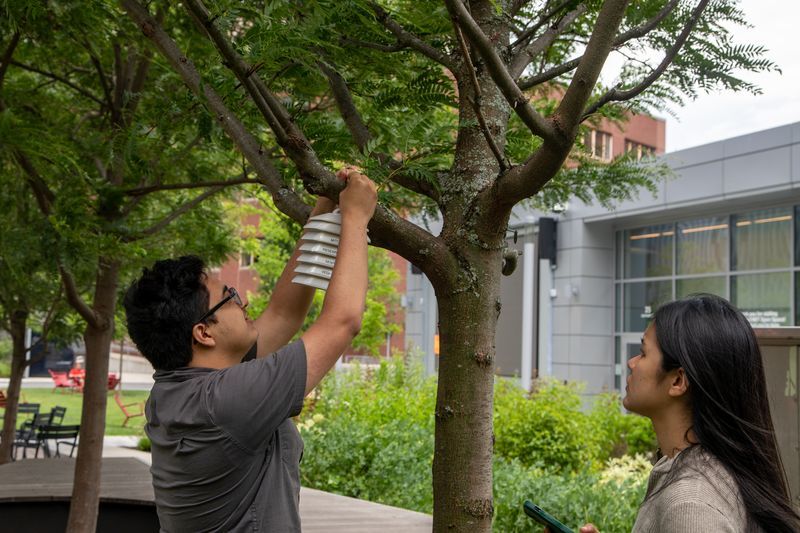
The Climate Resiliency team worked to mitigate the effects of urban heat islands, particularly on the MIT campus and in other parts of Cambridge, as well as in Chelsea, located just outside of Boston. They’ve worked with partners on campus and throughout the city of Cambridge, and also with Green Roots, a Chelsea-based environmental justice organization aiming to increase tree canopy coverage in Chelsea. The team members have said that their work has highlighted the importance of collaboration and bringing stakeholders together to share ideas and develop more comprehensive solutions. They also appreciated the practical, hands-on aspect of this program, which extended beyond research and planning, but also to planting trees and interacting with the people living near and caring for the trees.
“A lot of the climate science work that I've done in the past has felt a little bit removed and not always applicable to people who are already experiencing the effects of climate change,” said Das. “Through this work, I’m able to see how the research we're doing is actually helping people right now."
The Food Systems project built on over a decade of student- and staff-led efforts to develop robust gardening and food production on campus. Part of this project now included mobile farm carts, a type of flexible infrastructure that supports growing plants that can be moved and repositioned across campus, rather than being fixed at a singular site. The ultimate goalof this work was not only to grow food, but also to foster interdepartmental collaborations supporting climate mitigation. With this objective in mind, Rapaport and Wergeland say they’ve valued the feedback and ideas they’ve gained through many conversations with students, faculty, and staff throughout the Institute who are also passionate about this work.
“The ‘MIT Farm’ concept is not just a physical space, but a proposed framework for engaging with the MIT community and beyond the MIT community,” said Rapaport. “We're also working with external partners to create valuable collaborations and situate MIT's campus as one piece of a broader ecological and social network.”
The MITOS Decarbonization Accelerator team is exploring ways MIT can move toward zero emissions, particularly in building heating systems. At MIT, the buildings currently use a steam system fueled by natural gas which is very common across similar size and age campuses. The team is looking at ways to move toward a more sustainable source, carefully considering how other options would impact the campus and campus operations, as well as the water use involved and the potential impact on the Charles River.
“I think one of the highlights of this program [was] all of the opportunities for interactions with different people,” said Wang. “Right at the beginning, we were taken to the Central Utilities Plant, which I previously hadn’t known anything about. I really enjoy[ed] the kind of interactions we’ve had not only with students, but also with facilities and campus staff. That's not something that you typically get from lectures in a classroom.”
These projects will continue to grow at MIT and beyond after the summer season. The Food Systems project has evolved into a fall pilot “grab n’ go farm stand” partnership with MITOS, the MIT Farm Club, the Department of Anthropology, and Hannan Healthy Foods of Lincoln, Massachusetts. The Climate Resiliency project will continue in January during IAP with an expanded partnership that now includes the Massachusetts Executive Office of Energy and Environmental Affairs, while the Decarbonization Accelerator will remain an ongoing learning platform for students to advance data-driven research on campus decarbonization.
Header image courtesy of Ken Richardson.